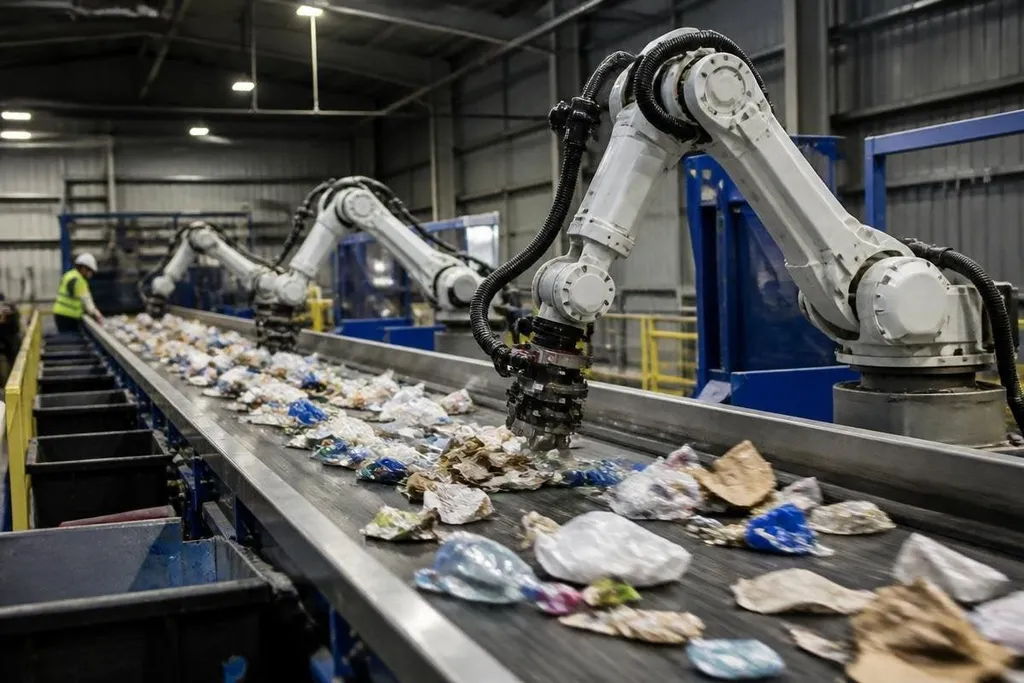
Recycling robots sort materials that arrive mixed together on a conveyor. Cameras, software, and robotic arms help separate items that are hard to identify by hand, while reducing the amount of repetitive sorting work people must do.
For a waste manager, the useful question is practical: can the robot recover more material without slowing the line or creating new safety problems?
- Cameras identify materials as they move past the robot.
- Robotic arms or air jets move selected items into separate bins.
- The result depends on clean data, steady conveyor flow, and regular maintenance.
How the sorting process works
A recycling robot starts with a moving stream of material. Cameras inspect each item, while software checks visible features such as shape, color, size, and position.
Some systems also use near-infrared sensors, which help tell different plastics apart by how they reflect light. The system then assigns an action to each item.
A robotic arm may pick a bottle from the belt, while an air jet can push a light object into another lane. The choice depends on the material, the item’s position, and the required speed of the line.
This process works best when the conveyor keeps a steady pace and items have enough space between them. If objects overlap, the software has less information to work with, and the arm may not have a clear path to the target.
What changes for waste facilities
The main change is where people spend their time. A robot can handle repeated picks from a conveyor, while staff focus on machine checks, quality control, blocked equipment, and material that needs a closer look.
That does not remove the need for human workers. Someone still has to inspect the output, fix damaged equipment, clear unsafe blockages, and decide how the line should handle new packaging or changing waste loads.
Robots can also give managers a clearer view of line performance. A system may record what it identifies and where it sends each item, giving the facility more information than a manual count alone. The value depends on how accurate those records are and whether staff use them to adjust the process.
A recycling manager comparing a pilot needs the sorter, material mix, line speed, test date, and measured result in one report. Recycling robotics reports from Robot24.com can put those details beside the claim, giving the manager a firmer basis for judging where the machines still struggle.
Where recycling robots still struggle
Mixed waste is difficult because the robot sees the item, not the full story behind it. A container may be dirty, crushed, partly covered, or placed beneath another object. Labels, food residue, dark colors, and unusual packaging can also make identification harder.
The robot’s gripper has limits too. Soft film, tangled material, and small objects can be difficult to pick without disturbing nearby items. A system that works well with bottles may need different tools and software for paper, metal, cartons, or electronic waste.
The line itself matters as much as the robot. A poorly placed camera, uneven lighting, worn conveyor belt, or full collection bin can reduce the number of correct picks. Maintenance is part of the system, not a task saved for later.
I’d judge a recycling robot by the material it recovers during a normal shift, not by the speed shown in a demo.
Before buying a recycling robot
Use this checklist when comparing a system with manual sorting or another machine:
- Name the material: define the exact items the robot must find and move.
- Check the line: measure belt speed, item spacing, lighting, and available floor space.
- Ask for failure data: find out how the system handles dirty, damaged, hidden, or unfamiliar items.
- Plan human work: assign responsibility for checks, blocked belts, software changes, and repairs.
- Count the full cost: include installation, grippers, sensors, service, training, and downtime.
- Set a useful test: compare recovered material and reject levels during normal operating conditions.
A recycling robot makes sense when it solves a defined sorting problem and fits the rest of the line. The next question for each facility is specific: which material is being lost today, and can a robot recover enough of it to justify the equipment and upkeep?